
The Complete Guide to Track & Field Spikes (Shoes, Pins, and Event-Specific Picks)
Summary
Track spikes are event-specific performance tools, not just race-day fashion. The right spike depends on your event, surface, experience level, and meet rules. This guide breaks down spike shoes, pin types, spike length, field-event footwear, surfaces, legality, and how to avoid wasting money on the wrong pair.
Heads up: some of the links below are affiliate links.Translation? If you buy through them, we get a small kickback to keep the lights on and the blocks set. Doesn’t cost you a cent more, just fuels more calculators, guides, and gear breakdowns for you. So, if you're down to support us and score some cool stuff, click away. Thanks for being awesome! Full disclosure here.
Free help: Not sure what category of spike you actually need? Grab the CoachXPro Spike Buying Cheat Sheet and stop guessing.
Spikes are one of the most misunderstood pieces of track equipment.
Some athletes buy the most expensive pair they can find and assume that means speed. Some parents buy whatever looks the most “serious.” Some beginners wear spikes way too early, way too aggressively, or for the wrong event entirely.
That is the wrong way to do it.
Spikes are tools.
Not trophies.
Not fashion.
Not magic.
The best pair is the pair that matches the athlete, the event, the surface, and the actual needs of the moment.
And yes, that matters a lot more than most people think.
Why do track spikes matter?
From a clean block start to a stable triple jump plant, spikes affect traction, posture, force transfer, and how the shoe interacts with the ground.
The wrong spike can make an athlete feel:
too aggressive
too unstable
too beat up
too stiff
or just plain awkward
The right spike can help the athlete feel more connected to the event.
That does not mean every new athlete needs spikes immediately.
If a beginner has never had real technical training, spikes are not going to magically fix bad mechanics. They are not like football cleats where the sport basically demands them right away. Many new athletes can train for a while in normal running shoes before spikes become necessary.
That said, once an athlete starts competing seriously in a specific event, spikes or event-specific footwear usually make a lot more sense.
And for throwers, a basic pair of throwing shoes can often be worth getting relatively early because they make technical work easier and usually feel much better on the knees than random trainers.
What are track spikes, exactly?
Spike shoes vs. spike pins
When people say “spikes,” they usually mean one of two things:
Spike shoes — the full shoe built for a specific event
Spike pins — the metal or plastic tips screwed into the sole
In everyday track talk, most athletes use “spikes” to mean the shoe.
That is how we are using it for most of this article.
What makes spikes different from flats or trainers?
Track spikes are built for more direct interaction with the track or runway.
Compared with normal trainers, they usually have:
less cushioning
more event-specific structure
a more aggressive platform
a spike plate or traction-focused outsole
lighter materials
Compared with racing flats, they are usually more specialized and more aggressive.
Why some events use spikes and others use specialty shoes
Not every event uses the same kind of footwear.
A 100m sprinter does not need the same shoe as a miler.
A high jumper does not need the same shoe as a triple jumper.
A shot putter does not need the same shoe as a discus thrower.
That is why the first buying rule is simple:
Buy by event first.
How do you choose the right spike?
If you remember one framework from this entire article, make it this one.
Buy in this order
Event
Experience level
Surface and meet rules
Budget
Fit
Most people buy in almost the exact opposite order.
They look at price, brand, or hype first.
Then they try to force the shoe to fit the athlete.
Bad move.
Choose the event category first.
Then ask whether the athlete needs something forgiving or aggressive.
Then make sure the shoe actually works on the surfaces and under the rules the athlete will face.
Then think about budget.
And finally, make sure the fit is right.
Need the simple version? Grab the free CoachXPro Spike Buying Cheat Sheet for the fast buy-by-event breakdown.
What spikes should you wear for each event?
Sprint spikes (100m to 400m)
Sprint spikes are built for aggression.
They are usually:
very light
very stiff through the forefoot
low or minimal in the heel
designed to keep the athlete up on the balls of the feet (curved)
built with a rigid plate, often Pebax-based or similar
Most sprint spikes have 7 to 10 pins in the forefoot and a very direct feel.
They are best for:
100m
200m
400m
short hurdles
They are usually best for athletes who:
are true sprinters
can handle an aggressive shoe
already have decent mechanics
Common mistake:
Buying the stiffest sprint spike possible for a brand-new athlete who is not ready for it.
Hurdle spikes
Hurdlers usually live somewhere between sprint aggression and controlled landing.
A lot of hurdlers do well in:
flexible sprint spikes
or slightly more forgiving middle-distance spikes with a small cushioned heel
Why?
Because hurdlers still want forefoot pop, but the rhythm of hurdling and the landings between barriers can make a little extra forgiveness useful.
Middle-distance spikes (800m to mile)
Middle-distance spikes are the middle ground.
They usually offer:
enough plate stiffness for speed
more forgiveness than a pure sprint spike
slight heel cushioning
better versatility for mixed-event athletes
They are often the best one-pair solution for athletes who run:
400m / 800m
800m / 1500m
mile-focused races with a need for some pop and some comfort
Common mistake:
Forcing a pure sprint spike onto an athlete who really lives in the 800m or mile.
Distance spikes (3000m to 10,000m, XC variants)
Distance spikes are usually more flexible and more forgiving.
They prioritize:
comfort over many laps
smoother mechanics
lower cumulative foot and calf stress
enough traction without turning the shoe into a sprint weapon
Cross-country versions may have:
more lugs
different outsole patterns
longer pins or more mud-friendly traction depending on conditions
water-resistant uppers (often using materials like Vaporweave or engineered mesh) and drainage holes to help release water and mud quickly
Common mistake:
Using an aggressive sprint spike for long races because it “feels faster.”
Long jump and triple jump spikes
Long jump and triple jump shoes are not just sprint spikes with a different label.
They are built to handle runway speed and event-specific forces.
Long jump spikes usually prioritize:
runway speed
stable planting
more heel cushioning than a standard sprint spike
controlled landings
Triple jump spikes usually need more:
durability
support
cushioning through repeated violent ground contacts
stability across the hop, step, and jump phases
Triple jump spikes, in particular, often need a sturdier feel than many athletes expect.
High jump spikes
High jump spikes are different from most other track shoes because they often use both forefoot AND heel spikes.
That extra grip matters during the curved approach and takeoff mechanics.
High jump spikes often feature:
heel spikes
forefoot spikes
strong midfoot support
sometimes asymmetrical designs for the takeoff foot
secure lockdown systems like straps
Pole vault spikes
Pole vault spikes need to support speed, stability, and a confident plant.
They usually emphasize:
forefoot and midfoot structure
a secure upper
stable takeoff feel
a platform that supports the plant into the box
They are built for a different kind of runway demand than most flat sprints and are similar to a long jump or triple jump spike. In practice, many young pole vaulters tend to use a long or triple jump shoe when first starting out.
| Event | Shoe Construction | Why It Matters |
|---|---|---|
| Long Jump (LJ) | Forefoot pins + reinforced heel, stable midfoot | Runway speed with controlled plant; cushioning for landings |
| Triple Jump (TJ) | Sturdier heel, durable upper, secure lockdown | Withstands hop-step-jump impacts and repetitive landings |
| High Jump (HJ) | Pins in forefoot **and heel**; asymmetrical sole options | Sure-footed angled approach and takeoff grip |
| Pole Vault (PV) | Rigid plate, reinforced midfoot/forefoot | Stable plant and explosive takeoff from the box |
Throwing shoes (shot put, discus, hammer, javelin)
Throws footwear is its own world.
For shot put, discus, and hammer, the main question is usually:
Are you a glider or a spinner?
Glide shoes usually offer:
more grip
more resistance against uncontrolled slipping
a more stable platform
Spin or rotational shoes usually offer:
smoother outsoles
easier turning via curved soles that put throwers a bit more on the ball of the feet
better rotational flow
a more circular design on the sole
Hammer and discus shoes often use very smooth, rounded outsoles to help the athlete rotate efficiently.
Shot put shoes often have a slightly wider, flatter base to help with stability.
Javelin is different.
Javelin spikes or boots usually feature:
forefoot and heel spikes
more support
more structure through the approach and plant
sometimes extra ankle support
They are built for an entirely different movement pattern than rotational throwing shoes.
Want actual product picks instead of just categories? Start with our future best spikes by event guides:
Best Sprint Spikes
Best Hurdle Spikes
Best Middle-Distance Spikes
Best Distance Spikes
Best Jump Spikes
Best Throwing Shoes
What spike pins should you use?
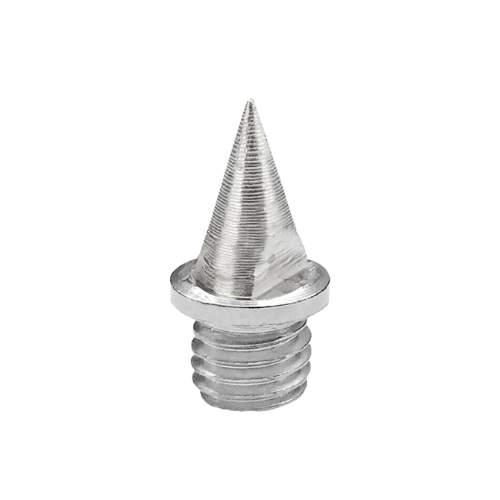
Pyramid Spikes
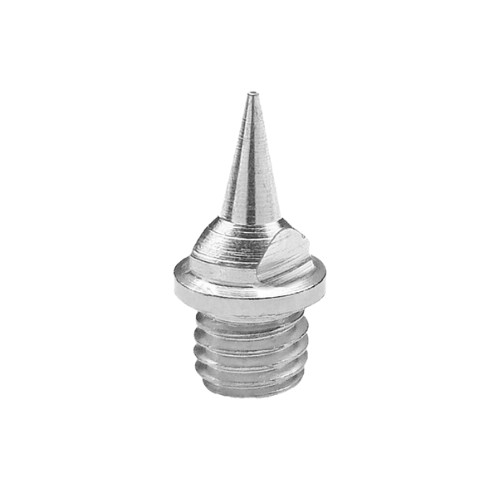
Needle or Slim Spikes
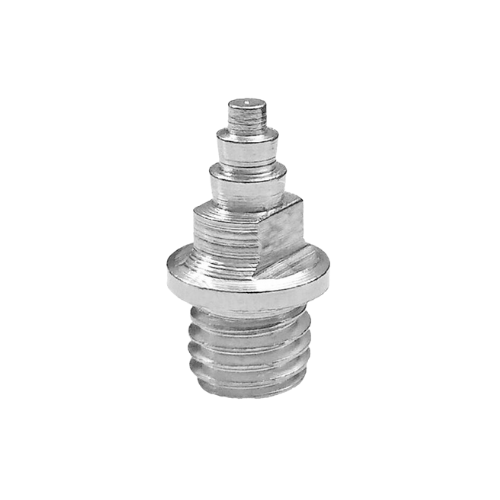
X-mas Tree/Compression Spikes
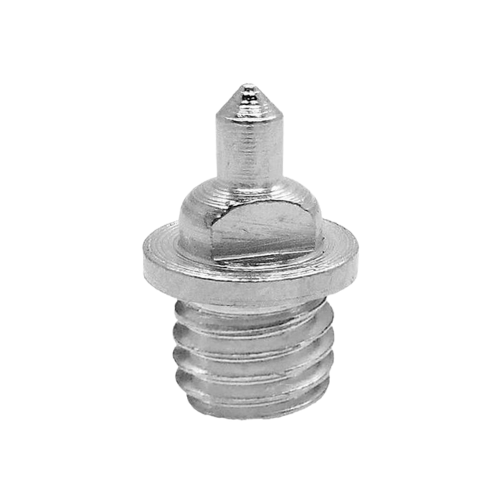
Tartan Sikes
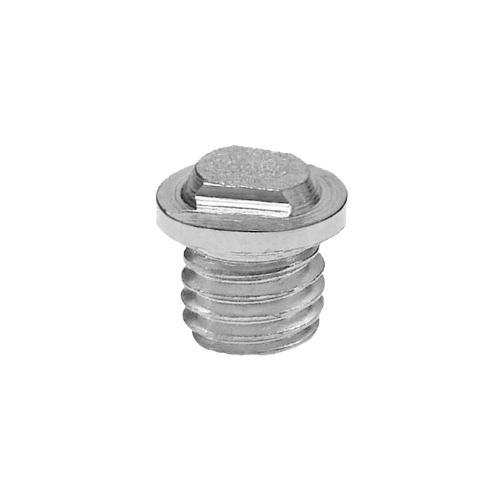
Studs or Blanks
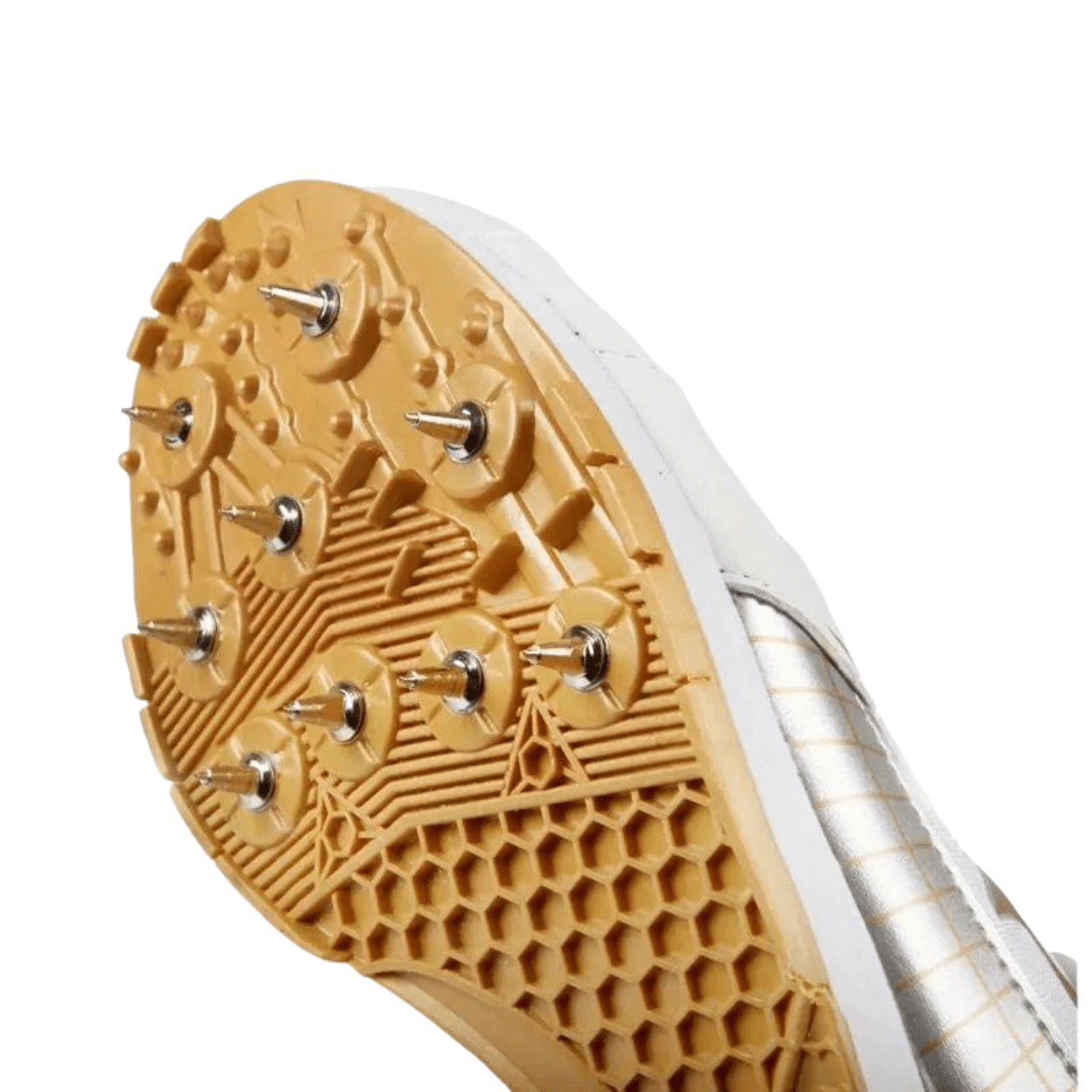
Permanent Spikes
Pins matter.
But most athletes still overcomplicate them.
The right pin depends on:
surface
facility rules
weather
event
how aggressive of a feel the athlete wants
A few quick rules
Needle pins are very aggressive and usually best on rubber tracks when allowed.
Christmas-tree pins are a strong all-around option on modern track surfaces.
Pyramid pins are common outdoors and in cross-country situations.
Blanks are useful when a facility bans metal pins.
Permanent spikes feel great when new, but once they wear down, the whole shoe is on the clock.
Pyramid Spikes
Best for: Dirt, grass, and mud terrains, commonly used in cross-country events.
Design: Conical shape providing a good grip without excessive traction that might hinder movement.
Size: Usually not more than 1/4 inch.
Needle or Slim Spikes
Best for: All-weather tracks.
Design: Slimmer and sharper, providing excellent grip on rubber tracks.
Size: Ideal size is 3/16 inch as larger spikes tend to stick into the track.
X-mas Tree or Compression Spikes
Best for: Rubber and tartan surfaces.
Design: Resemble a Christmas tree, preventing "sticking" on rubber surfaces while providing good traction.
Tartan Spikes:
Best for: Rubber tracks only.
Design: Look like dull needle spikes, designed specifically for rubber tracks to provide adequate grip without damaging the surface.
Studs or Blanks
Best for: Cross country and sometimes asphalt.
Design: Lack a spike, providing a compromise between traction and protection of the surface.
Permanent Spikes
Unlike the traditional replaceable spikes, some track shoes come with permanent spikes embedded into the sole. These spikes are designed to offer a longer lifespan and are often found in elite-level competition shoes. The benefit of permanent spikes lies in their structural integrity and the fine-tuning of their design to match the shoe's overall ergonomics. However, the inability to replace these spikes can be a downside as it necessitates the replacement of the entire shoe once the spikes wear down.
| Pin Type | Best For (Surfaces) | Design & Notes | Typical Size |
|---|---|---|---|
| Needle / Slim | All-weather rubber (Mondo/tartan), indoor (where allowed) | Very sharp/slim for excellent bite on rubber; can “stick” if too long | ~3/16" common indoors; check meet rules |
| Christmas-Tree (Compression) | Rubber/tartan | Tapered “tree” shape that grips without over-sticking | 1/8"–1/4" typical |
| Pyramid | Dirt/grass/mud; also many outdoor tracks | Conical; strong grip without excessive penetration | Up to 1/4" for track; up to 1/2" for XC |
| Studs / Blanks | XC flats; indoor where pins banned; sometimes asphalt | No protruding pin; protects delicate surfaces, mild traction | N/A |
| Tartan | Rubber tracks only | Duller, rubber-friendly pin meant to avoid surface damage | Usually ≤1/4" |
| Permanent (non-replaceable) | Elite specialty shoes | Integrated into plate; great feel but not serviceable | Fixed |
What spike length should you use?
Most athletes do not need to get fancy here.
Safe starting point for many high school athletes
A short pin — often around 1/8 inch — is a safe place to start if you are not sure. Most high school competitions these days require pins equal to or less than 3/16 inch to help mitigate premature track wear.
Common outdoor default
Many outdoor tracks work well with 1/4-inch pins. Most spikes you will buy come with a set of 1/4-in pins by default.
When longer pins make sense
Longer pins can help in:
muddy cross-country conditions
loose grass
very sloppy terrain
But longer is not automatically better.
On many tracks, anything too long can:
damage the surface
violate meet rules
feel too grabby
actually hurt rhythm instead of helping it
Bottom line
Always check:
meet rules
facility rules
indoor venue rules
championship legality
What surfaces and meet rules change your spike choice?
Your spike setup does not live in a vacuum.
Surface matters.
Rules matter.
And some facilities are very picky.
For major competitions, shoe legality can go beyond just pin length. World Athletics’ current athletic shoe regulations, effective from January 1, 2026, require approved shoes in world ranking competitions and provide separate shoe-control guidance and a live approved-shoe system through CertCheck. That matters more for elite and championship-level competition, but it is still smart for serious athletes and coaches to know.
What should beginners, parents, and coaches do first?
If you are a parent buying a first pair
Your job is not to buy the fanciest spike.
Your job is to buy the pair that makes sense.
Start with:
correct event category
reasonable budget
decent durability
a good fit
Do not start with:
the coolest-looking spike
the most expensive spike
a shoe from the wrong event category
If you are a new athlete
Ask:
What is my actual event?
Am I mostly sprinting, running distance, jumping, or throwing?
Do I need a very aggressive shoe right now?
Will one more versatile pair cover what I do?
If you do not know yet, choose the more versatile option.
If you are a coach helping families choose
Your job is to simplify the process.
Tell them:
buy by event first
do not overspend too early
fit matters
more aggressive is not automatically better
one good-enough shoe usually beats one wrong “elite” shoe
When one pair is enough
One pair is usually enough if:
the athlete is newer
the athlete is budget-conscious
the event range is not too extreme
the athlete is mainly mid-distance or crossover sprint / 800
When two pairs may make sense
Two pairs may be worth it if:
the athlete competes in very different event types
the athlete is serious and experienced
one spike clearly compromises another event
Example:
A serious athlete doing both long jump and 100m may eventually want different pairs.
What do track spikes cost?
You do not need to spend top dollar to make a smart purchase.
In fact, most athletes should probably live in the entry-level to mid-tier range until they are clearly serious enough to benefit from something more specialized.
Use those prices as orientation, not gospel.
The smartest buying move for most people is usually:
correct category
solid fit
decent value
enough performance for the event
Want actual product recommendations? This article is the hub. Use it with your future money pages:
Best Sprint Spikes
Best Hurdle Spikes
Best Middle-Distance Spikes
Best Distance Spikes
Best Jump Spikes
Best Throwing Shoes
How do you care for spikes and make them last?
Treat spikes like equipment.
Not like shoes you throw into the car and forget about.
Basic maintenance rules
unscrew and clean pins regularly
air-dry after wet sessions or meets
do not bake them in a hot car
inspect the plate for cracks or damage
replace pins when they get worn flat or stuck (for stubborn pins, use a pair of needle nose pliers)
If you can afford it
A practice pair and a competition pair can help your good spikes last longer, but they should be of the same type and feel. In fact, it’s likely the best idea to just get the same exact pair so as not to compromise performance feel or foot comfort and stability.
Useful accessories
These are the kinds of add-ons that actually help:
spike wrench (should come with just about every pair of spikes you ever purchase)
replacement pin kit
shoe bag
drying inserts
What tech matters and what might get banned?
Modern track footwear is changing fast.
The big themes are:
carbon plates
advanced foams
more aggressive energy return
elite models with very tuned geometry
permanent or semi-integrated spike systems in some shoes
That can absolutely improve performance.
But more tech does not always mean the shoe is legal for every competition.
World Athletics maintains athletic shoe regulations, FAQs, shoe-control guidance, and an approved-shoe list through CertCheck for ranking competitions. Athletes in those competitions are responsible for making sure their shoe is approved and identifiable by model. That is not something only shoe nerds should care about anymore.
For most high school athletes, this is not something to obsess over daily. If you don’t know how to run appropriately, spending the money on a “high tech“ spike wont make you any faster either.
For serious athletes chasing higher-level competition, it matters.
Where should you go next?
This guide is your broad spike hub.
If you want help choosing a category fast, start with the Spike Buying Cheat Sheet.
If you want actual product picks, start with the event-specific buying pages:
Best Sprint Spikes
Best Hurdle Spikes
Best Middle-Distance Spikes
Best Distance Spikes
Best Jump Spikes
Best Throwing Shoes
Best Cross Country Shoes
CoachXPro Take
The biggest spike-buying mistake is acting like every athlete needs the most elite model.
They do not.
The shoe doesn’t make the athlete. It is not the tools that make a craftsman good, but rather how they are employed.
Most athletes need:
the right category
the right fit
the right surface match
the right amount of aggression for where they are now
That is the move.
Not hype.
Not overspending.
Not guessing.
Event match beats flex.
Fit beats hype.
Useful beats expensive.
Key Takeaways (TL;DR)
Buy spikes by event first.
Then buy by experience level.
Then check surface and meet rules.
Sprint spikes are aggressive. Distance spikes are more forgiving.
Jump and throws footwear are event-specific.
Pin type and pin length matter.
More expensive does not automatically mean better.
Most beginners should start simpler, not more elite.
FAQs
-
Most beginners should buy based on the event they actually do, not the most expensive model they see online. A more forgiving or versatile option is often smarter than an ultra-aggressive elite spike.
-
Not always. Sometimes the same shoe works just fine if you swap pin type or length. But some indoor venues ban metal pins or restrict certain pin types, so always check the facility rules.
-
That depends on how often they are used and how well they are cared for. Many athletes can get one to two seasons out of a pair, but pins often wear faster than the rest of the shoe.
-
Not usually. Throwing events need event-specific footwear. Rotational shoes, glide shoes, and javelin spikes are built for completely different movement demands than running spikes.
-
Sometimes, yes. A very stiff, very aggressive sprint spike can be too much for a beginner whose mechanics are still raw.
-
A short pin is usually the safest place to start. Many facilities and meets restrict pin type and length, so check the rules before competition.
-
Yes, often. A middle-distance spike is usually the best compromise for athletes who really live in both events.
-
Usually, yes. Long jump, triple jump, high jump, and pole vault all place different demands on the shoe.
Want more?
Still not sure what shoe makes sense for your event, level, or budget?
Get the free CoachXPro Spike Buying Cheat Sheet and join CoachXPro Track Brief for smart track insight, no fluff.
Related Articles
Best Sprint Spikes
Best Hurdle Spikes
Best Middle-Distance Spikes
Best Throwing Shoes
Why Sprinters Wear Spikes
Best Track Spikes for Beginners
Triple Jump Spikes:
Design & Construction: Triple jump spikes are crafted to provide support, cushioning, and traction through the three phases of the triple jump: hop, step, and jump.
Cushioning: They often have enhanced cushioning to absorb the shock from the intense landings involved in the triple jump.
Spike Plate: The spike plate in triple jump spikes is designed to provide a good grip and traction on the track, which is essential for gaining speed and stability through each phase of the jump.
Supportive Upper: A supportive upper material and a snug fit are crucial to keep the foot securely in place during the intense motions of the triple jump.
Heel Support: Some designs offer additional heel support to provide stability during the hop phase of the triple jump
High Jump spikes are designed to allow a firm plant for the takeoff foot, featuring spikes both at the rearfoot and forefoot to ensure grip during the arching phase over the bar1.
High Jump Spikes:
Design & Construction: High jump spikes are designed to maximize the vertical height of athletes over the bar. They feature spikes in both the front and heel of the shoe to provide traction and minimize the risk of slipping during take-off.
Heel Spikes: Unlike sprint spikes, high jump spikes have spikes on the heel to provide additional grip during take-off.
Sole Design: Some high jump spikes feature an asymmetrical sole design to cater to the athlete's take-off foot.
Midfoot Support: They often have adjustable midfoot straps or other mechanisms to provide a locked-down feel, ensuring stability during the jump.
Plate Material: Materials like Pebax are used in the construction of the spike plate to ensure a lightweight and flexible platform for jumpers
From a clean block start to a stable triple-jump hop, spikes influence traction, posture, and energy transfer. Choose them like tools: matched to event demands and surface rules.
But — and perhaps this is controversial — don’t buy track spikes yet unless you have had some technical training (ie, running form practice). They aren’t going to magically make you faster until you know how to use them. They aren’t a necessity right away like you might expect for field sports that require them for change of direction (football, soccer, lacrosse, etc).
I do think it’s beneficial to grab a pair of cheap throwing shoes early on, once you have decided that is something you want to continue to do. They will spare your knees and make the technical practices and feel that much easier.
| Surface | Recommended Pins | Notes |
|---|---|---|
| Dirt / Crushed Granite | Pyramids | Grip without sinking too deep |
| Asphalt | XC flats / blanks | Hard surface—avoid metal pins |
| All-Weather Rubber (Tartan/Mondo) | Needle, Christmas-tree, short pyramids | Many tracks cap at ≤1/4″; check meet rules |
| Indoor (temporary carpets/boards) | Short needles or blanks (if pins limited) | Some facilities ban metal pins entirely |
| XC Grass / Mud | Pyramids / XC studs | 1/2″–5/8″ in sloppy conditions |
(Use these as orientation; pick what fits and meets your meet’s rules.)
| Category | Example Models | Typical Price |
|---|---|---|
| Sprint | Nike Maxfly, adidas Prime SP2, Puma evoSPEED | $150–$250 |
| Mid-Distance | Nike Victory/Dragonfly MD, New Balance MD-X | $120–$200 |
| Distance / XC | Nike Dragonfly XC, adidas Avanti, ASICS Hyper LD | $100–$200 |
| Long/Triple/High Jump, Pole Vault | Nike PV Elite / HJ Elite, adidas LJ/TJ & HJ Pro | $120–$200 |
| Throws (Spin / Glide / Javelin) | Nike Zoom Rotational, ASICS Throw Pro, adidas Javelin | $90–$180 |
| Entry-Level (multi-event) | ASICS Hyper series, Saucony Vendetta, NB Sigma Aria | $65–$120 |
👉 Build beyond shoes: explore Training Program Guides and grab a Free Athlete Consultation for personalized picks.
| Track Spike Type | Surface | Events |
|---|---|---|
| Pyramid | Asphalt | 800m+ (use flats/blanks preferred), caution on hard surfaces |
| Synthetic (rubber/Mondo) | 800m+, XC; common outdoors (check length limits) | |
| Natural (dirt/grass) | 800m+, XC; longer pins (up to 1/2") for mud | |
| Needle | Asphalt | Sprints/Jumps/800m+ not recommended on asphalt; risk of slip/damage |
| Synthetic | Sprints, Jumps, 800m+; excellent bite on rubber—watch length | |
| Natural | Not advised (can core into dirt/grass) | |
| Compression (X-mas Tree) | Asphalt | Sprints/Jumps—generally avoid metal pins on asphalt |
| Synthetic | Sprints, Jumps; grips rubber without over-sticking | |
| Natural | Usually not needed; pyramids or studs work better | |
| Tartan | Asphalt | Sprints/Jumps—avoid pins on asphalt |
| Synthetic | Sprints, Jumps; track-friendly dull profile | |
| Natural | Not applicable | |
| Permanent | Asphalt | Javelin/approach only if specified; otherwise avoid |
| Synthetic | Sprints, Jumps, Javelin (shoe-specific) | |
| Natural | Not typical; use appropriate XC studs/flats |
Find the right shoe for your event—not the loudest marketing claim.
The best starting point depends on your events, experience, budget, fit and venue rules. Use the event-first finder below, then compare real manufacturer models without assuming expensive means better.
Quick answer: Sprinters generally need sprint-oriented traction and a secure upper; 800m–mile runners usually want a balance between propulsion and forgiveness; distance runners benefit from a comfortable, stable race-specific design. Long jump, triple jump, high jump, pole vault and throwing events have distinct footwear demands. The correct model is the one that fits your event and feet—and meets the rules at your venue.
Track & field shoe finder
Answer three questions for a practical shoe category and buying checklist. This is guidance, not an automated claim that one product is objectively the best.
Sprint spike with a secure fit
Choose a sprint-oriented shoe and prioritize fit, heel security and manageable plate stiffness.
- Try the shoe with race socks.
- Check facility pin rules.
- Confirm the retailer's size and return policy.
Manufacturer model examples appear below only where we've checked their event category.
Selection criteria reflect event demands and practical buying judgment. No performance prediction, medical advice, lab ranking, stock lookup, or real-time price feed is being generated.
What footwear does each event call for?
Start with event mechanics and your skill level. Don't assume all track shoes are interchangeable.
| Event group | Shoe category | Prioritize | Watch out for |
|---|---|---|---|
| 100m–400m / sprint hurdles | Sprint spikes | Secure upper, forefoot traction, appropriate plate stiffness | An overly aggressive plate for a first-season athlete |
| 800m–mile / 400+800 | Mid-distance or versatile race spikes | Comfort and grip with manageable stiffness | One extreme sprint model forced onto mixed distances |
| 3000m–10,000m | Distance track spikes | Foot comfort, stability, traction across many laps | Very little cushioning or poor lockdown |
| Cross-country | XC spikes or appropriate flats | Terrain-specific traction, drainage, fit | Metal pins on prohibited or hard surfaces |
| Long jump / pole vault | Appropriate runway spike | Approach grip, takeoff support and secure fit | Assuming pure sprint spikes suit every runway athlete |
| Triple jump / high jump | Dedicated TJ / HJ footwear | TJ landing support; HJ approach and takeoff traction | Using generic distance spikes as a specialist substitute |
| Shot glide / rotational throws | Glide or rotational throwing shoes | Controlled grip for glide; smooth rotational outsole for spinning | Buying running spikes for the throwing circle |
| Javelin | Javelin spikes/boots | Approach grip, plant support, heel traction as designed | Substituting rotational throwing shoes |
Real shoe models worth comparing
These are starting points for four common buying situations—not a ranking of all shoes or claims of CoachXPro wear testing.
Nike Zoom Rival Sprint
Designed for sprinting, with a reinforced upper and a replaceable-pin configuration. A practical model to compare before spending more on specialized sprint hardware.
Consideration: Fit and plate feel matter more than its price; verify the size chart.
adidas Adizero Sprintstar
An event-specific sprint option from adidas. Compare its fit and current cost against entry sprint models before choosing solely on brand.
Consideration: Verify the exact model and colorway in the retailer listing; promotions vary.
Nike Zoom Rival Distance
Manufacturer describes this as an adaptable middle- and long-distance spike. Worth comparing when one athlete covers more than one race distance.
Consideration: Not automatically the correct pick for a specialist sprinter, XC course or jumping event.
Nike Dragonfly 2
A more specialized distance racing option with the manufacturer's full-length ZoomX foam and distance-track positioning.
Consideration: Cost, fit and race needs must justify an upgrade; verify competition legality if applicable.
How these examples were selected
We verified that the named models are listed in their manufacturers' current track catalogs and checked the manufacturer-stated event positioning. We did not obtain or laboratory-test these shoes, verify all sizes in stock, or compare every competing model. Model inclusions are editorial examples, not paid placements or universal “best” awards. Product catalog review: October 19, 2026. Recheck before purchasing.
Spike pins, surfaces and legality
Buying the right shoe also means choosing permitted pins and understanding the conditions of competition.
Pins: follow the venue
Pyramid, needle and compression-style pins interact differently with surfaces. Some tracks restrict length or shape, and some indoor venues ban certain pins. Never assume one length or shape is universally allowed.
Track vs. cross-country
XC traction depends on grass, mud and the course. Hard surfaces may require flats or other permitted footwear. Select pins for the actual venue instead of a generic “best” chart.
High-level shoe rules
For competitions governed by World Athletics shoe rules, verify the model against the applicable current regulations and official approved-shoe resources. Not every school meet uses the same process.
Official reference: World Athletics Competition Rules and Athletic Shoe Regulations; also check your school association and facility policy.
Best value is not always the lowest price
An inexpensive shoe in the correct category that fits well can be a better purchase than an expensive specialty model from the wrong event. Compare the regular price, current discount, size availability, return policy, replacement pins and expected use. When choosing between two sizes or lasts, fit can outweigh the price difference.
For multi-event athletes, decide which events matter most: a 400m/800m runner might prefer a more versatile shoe, while a triple jumper competing seriously should consider footwear designed for the repeated landing demands. There is no honest one-shoe-for-every-event winner.
Frequently asked questions
What are the best track spikes for beginners?
Start with the right event group, a manageable feel, reliable fit and a reasonable budget. Beginners who compete across several distances may benefit from a versatile model rather than the most aggressive specialist spike. There is no universal best beginner model.
Can I wear the same spikes for the 400m and 800m?
Often, yes. For athletes splitting time between those distances, a versatile middle-distance style can be a workable compromise. Try the shoes and account for which event is more important.
Should high-school athletes buy the most expensive super spikes?
Not by default. Fit, event suitability, permitted use and athlete readiness come first. A premium model makes sense only when its specific characteristics justify the added cost to that athlete.
How long should spike pins be?
There is no universal legal size for every surface or meet. Check the facility's current pin-length and pin-type restrictions and the competition rules before installing them.
Can discus or shot put athletes use running spikes?
Running spikes aren't generally designed for rotational or glide mechanics in a throwing circle. Choose appropriate throwing footwear; javelin is a separate category with runway spikes and plant support.
Are the prices on this page automatically updated?
No. This edition links to manufacturer listings so you can check their current price, size selection and availability. CoachXPro will identify an automatically refreshed price only if it is connected to a permitted, current retail data feed.
